Direct Answer
Start by scouting for a base with a large water source, abundant sand, and open building space. Use water and sand to establish early Gold production, spend Gold on Research, then replace manual hauling with conveyors, launchers, filters, pumps, and pipes. Explore beyond the factory for Fluxite, augments, creatures, and alien Artifacts as your technology expands.
Choose a strong starting location
The collected creator guide recommends scouting before committing to a factory site. Look for a large water source, plenty of sand, and enough open ground for production lines to expand. A small water pocket or cramped area can make the early Water-and-Sand route harder to organize.
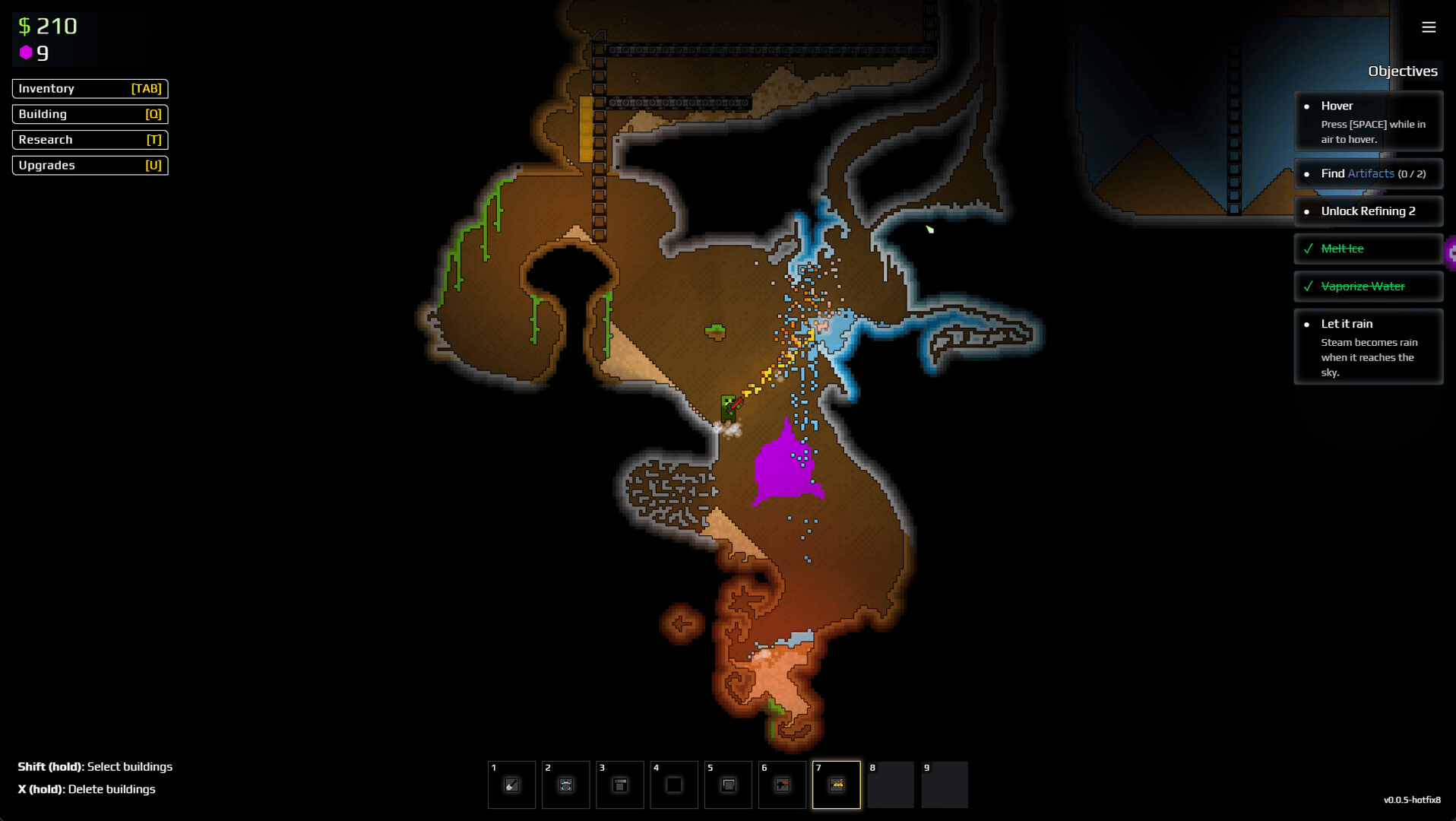
The minimap shows the area beyond the main screen, while active objectives can display yellow direction arrows. Use those tools to compare nearby terrain instead of building immediately at the arrival point. Exact world layouts are procedurally variable, so a universal base coordinate is To be confirmed and should not be invented.
Build the first Gold production loop
Gold is the currency used to unlock Research, and the official Beginner's Guide names the Shaker, Kinetic Press, and Planter Box as three core Gold-producing structures. Early production depends heavily on Water and Sand, with Wet Sand becoming an important input. A practical progression is secure Water and Sand, produce Gold, unlock Research, and expand the factory.
Gold should support infrastructure rather than remain idle when a useful Research unlock is available. More logistics and processing options can make later Gold production easier to automate. Exact best-order claims depend on the player's world and current version, so a single mandatory research order is To be confirmed.
Use the right logistics for each material
Conveyor Belts and Launchers move solid resources such as Sand, Residue, Cinder, Seeds, and Amethelis. Belts are placed horizontally, while Launchers can move resources vertically or diagonally and throw them from the higher end. The official guide says these core logistics structures operate without power and continue running when resources are present.
Filters sort solids with Allow or Block behavior, and Advanced Filters later handle solid, liquid, and gas resources while keeping the single-resource rule. Pumps, Pipes, and Liquid Vents transport fluids other than lava, but mixed-fluid pipelines cannot choose which fluid exits first. Separate fluid lines reduce the uncertainty created by the vent prioritizing the nearest liquid.
Learn refining, Research, and Upgrades
Heating moves a solid toward liquid or a liquid toward gas, while cold processing reverses those state changes. The Material Scanner upgrade helps identify how a resource can be refined or used in another process. Creator material also recommends obtaining that scanner early because interactions such as fire affecting Slag but not Spores are not always obvious.
Gold unlocks Research, while Fluxite unlocks Upgrades for inventory tools, weapons, and drones. Factory Level gates more advanced Research after performance milestones are reached. Aura later supports late-game Research, but its production chain belongs to Tier 6 systems rather than the beginner phase.
Controls that save construction time
The official Wiki documents C for selecting a structure, Ctrl+C for copying, and Ctrl+V for pasting repeated systems. It also describes a replace control for upgrading or adjusting existing layouts, while creator footage adds X-drag deletion, V for checking building footprint, and Q for the Building tab. Because some creator-described bindings may depend on current settings, any conflict with the live controls menu should be treated as To be confirmed.
The game provides ten hotbars with ten slots each, and the official guide describes Alt plus a hotbar number or Alt plus mouse wheel for moving between them. Creator material also describes W plus Space as a hover mode without collision for easier base movement. Keybinds can change or be remapped, so the in-game controls screen remains the final reference.
Automate, then keep exploring
Automation lets the factory continue producing while the player travels away from the base. Launchers are especially useful for moving resources quickly across vertical gaps, while a Grabber can selectively collect material matching what it already holds. Filters, drones, pipes, pumps, and processing machines extend that loop as production becomes more complex.
Exploration is also a progression system because Fluxite appears naturally underground, augments are scattered through the world, creatures can contribute resources, and Artifacts unlock benefits. Ancient ruins may even provide spaces that can be integrated into factory layouts. Exact Artifact locations and a universal exploration route are To be confirmed because the supplied sources do not provide a fixed complete map.
Core world and factory context
Sandustry treats individual pixels as physical resources with their own properties. Water can become Steam, Sand absorbs Water, and watered Seeds can grow into Flowers, so terrain and reactions are part of factory design. A guide must account for material behavior instead of treating the world as a static background.
The main progression loop moves from gathering and refining toward larger production chains and automation. Gold unlocks Research, Fluxite improves inventory tools, weapons, and drones, and Aura later supports late-game Research. Exact optimal order depends on the current world and unlocked technology, so this site does not invent a single mandatory build sequence.
Logistics shared by many guides
Conveyor Belts move solid resources horizontally, while Launchers can transport them vertically or diagonally. Filters sort materials with Allow or Block behavior, and Advanced Filters later work with solid, liquid, and gas resources. Pumps, Pipes, and Liquid Vents handle fluids other than lava under the level conditions documented by the official guide.
The core logistics structures described in the Beginner's Guide do not require power to operate. A mixed-fluid pipe can carry more than one fluid, but its Liquid Vent cannot filter the output and prioritizes the nearest liquid. Separating fluid lines and clearing stagnant solid pixels are therefore verified reliability principles rather than invented throughput formulas.
Research and upgrade context
Research unlocks structures and inventory items and is purchased with Gold. More advanced Research is gated by Factory Level, which represents tiered access earned through performance milestones. The supplied material does not provide one complete current Research tree, so missing costs and prerequisites remain To be confirmed.
Fluxite is used for Upgrades, including improvements to the Grabber, weapons, and drones. The official guide recommends the Grabber as a useful early investment because moving larger material chunks helps before automation is complete. Creator recommendations for weapon specialization are retained as creator context, not rewritten as mandatory official rules.
Version and evidence boundaries
The current official Wiki is used when its Early Access guidance conflicts with older Demo-era discussions. Creator videos can show practical layouts, controls, or failure cases, but unclear names and unsupported measurements are not promoted to official facts. This is especially important for tools, Artifact routes, mods, and material recipes that may have changed between versions.
Every page begins with the narrow answer supported by the collected evidence, then adds only related verified context. Unknown counts, timings, ratios, coordinates, and compatibility claims are marked To be confirmed. That boundary keeps a long guide useful without filling missing space with invented numbers.
Use this guide with the current Early Access build
Sandustry entered Early Access on August 13, 2026 and continues to receive official updates. The current official Wiki is the primary gameplay reference when it differs from an older Demo discussion, while Steam and Xbox listings are the primary platform references. A creator video can demonstrate a working layout, but it does not automatically establish a universal value or current-version rule.
Check the page's verified sources when an update changes a recipe, cost, tool restriction, platform feature, or interface path. This guide preserves confirmed numbers only where the supplied research names them and labels unresolved details To be confirmed. That approach keeps the answer usable for search while preventing an unsupported count, character name, redeem code, command, or production ratio from becoming false guidance.
Verified sources used
This page filters and consolidates the supplied research. Any detail not established by those sources is marked To be confirmed.